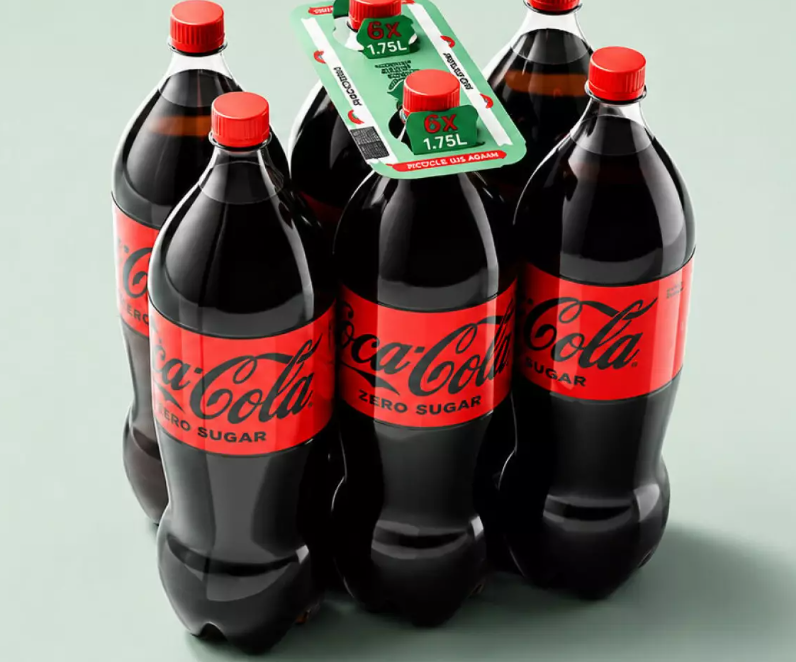
Coca-Cola and Coca-Cola Europacific Partners (CCEP) are conducting a limited retail trial in Germany and France of a new secondary packaging format for PET bottle multipacks. Instead of wrapping bottles together in conventional plastic shrink film, the trial uses strategically positioned adhesive dots combined with a rigid cardboard carrying handle.
Featured in ThePackHub’s Innovation Zone, the development explores whether the handling and stability required of beverage multipacks can be maintained while reducing the amount of secondary plastic packaging used.
The format is currently at the pilot testing stage, providing an opportunity to assess not only its packaging performance but also how consumers respond to a multipack that looks and behaves differently from a conventional shrink-wrapped format.
Replacing continuous shrink film
The trial brings individual PET bottles together using adhesive dots positioned at selected contact points. A rigid cardboard handle fitted to the assembled pack provides a carrying point for shoppers.
The adhesive connections are designed to provide sufficient stability as the multipack moves through transport, distribution, retail handling and consumer carrying. Once purchased, the bottles can be separated by gently twisting or carefully pulling them apart.
This removes the need for the continuous outer layer of plastic film normally used to contain the bottles as a single unit.
The approach follows a broader packaging reduction principle: rather than substituting one complete secondary packaging format for another, it considers how much material is actually required to perform the necessary containment and handling functions.
Designing for separation after use
Removing shrink film also changes the way consumers interact with the multipack.
Because the individual bottles are physically connected by adhesive dots, clear communication is being used to explain how they should be separated. Graphic illustrations and point-of-sale instructions form part of the trial to help consumers understand the unfamiliar opening process.
Once all of the bottles have been removed, the cardboard carrying component can be placed in the appropriate paper and cardboard recycling stream. The PET bottles continue through established bottle collection and recycling systems where these are available.
By limiting the shrink film used in the conventional format, the concept is intended to reduce the amount of secondary plastic associated with each multipack. The separate cardboard and PET components still rely on consumers placing them into the appropriate collection systems after use.
Testing performance and consumer acceptance
For a secondary packaging reduction of this kind to progress beyond a pilot, material savings are only part of the equation. The pack still needs to remain stable through the supply chain, be practical for retailers to handle and provide consumers with a secure way to carry multiple bottles.
The trial therefore provides Coca-Cola and CCEP with an opportunity to examine packaging stability, flexibility within the supply chain, retail handling and consumer acceptance.
Replacing continuous shrink film with discrete adhesive points could provide a route to reducing secondary plastic consumption while retaining the core handling functionality expected from a PET beverage multipack. The outcome of the pilot will help determine whether this approach can perform effectively across the different stages between packing and consumption.
Want to discover more packaging innovations?
Explore the latest developments and over 12,000 packaging innovations in the Innovation Zone.