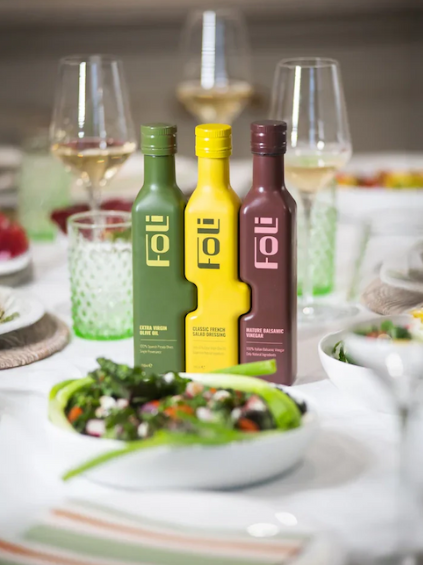
Featured in ThePackHub’s Innovation Zone, the launched Oil, Dressing & Vinegar Set uses matching bottle formats for olive oil, salad dressing and balsamic vinegar. Rather than treating each product as a separate packaging design, Foli uses common proportions, styling and graphic elements to create a visually unified collection.
The approach gives the primary packaging an additional role. As well as containing, protecting and dispensing the product, the bottles are designed to make the original packaging suitable for remaining on a kitchen worktop or being placed directly on a dining table, rather than requiring the contents to be transferred into separate serving bottles.
Creating a Consistent Packaging Architecture
Oil, vinegar and dressing are closely related products, but their packaging can often differ considerably in bottle shape, dimensions and visual presentation.
Foli has taken a different approach by treating the three containers as components of one packaging system. Each retains its individual function as a primary pack while following the same overall design language.
The bottles share distinctive proportions and a geometric profile, while different colours and graphics allow consumers to distinguish between the products. The olive oil is presented in green, the salad dressing in yellow and the balsamic vinegar in a darker burgundy tone.
This consistency can help create stronger recognition across the range while allowing each product to maintain a clear individual identity.
Extending Primary Packaging to the Tabletop
The concept also addresses what happens to packaging after it has been taken out of the cupboard.
Condiments are frequently transferred into separate bottles or serving vessels when presentation is important. Foli instead intends the original packaging to remain suitable for use at the table, combining its conventional packaging functions with a more decorative presentation role.
That makes visual design a functional part of the packaging proposition rather than simply a branding consideration. The bottle needs to work effectively during storage and dispensing while also forming part of the dining environment.
The coordinated format is particularly evident when all three bottles are placed together, where their matching silhouettes create the appearance of a deliberately designed set rather than three unrelated products.
Designing Product Ranges as a Single System
Foli’s approach demonstrates how packaging differentiation does not necessarily require every product within a range to have a different structural format.
Using a common architecture can instead make the relationship between products more apparent. Individual graphics and colours provide differentiation, while the shared bottle design connects the wider range.
Here at ThePackHub, we see particular interest in the way the three primary packs have been considered as parts of a single packaging system. The format creates visual consistency while allowing the bottles to double as tabletop serving containers, extending their role beyond storage and product protection.
For food brands developing complementary product ranges, this type of coordinated packaging approach could provide an interesting way to balance individual product identification with a stronger overall range identity.
Want to discover more packaging innovations?
Explore the latest developments and over 12,000 packaging innovations in the Innovation Zone.