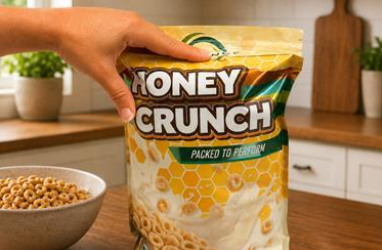
SunDance has expanded its POUCH³ flexible packaging format into the cereal market, offering an alternative to the conventional combination of a paperboard carton and inner bag.
Featured in ThePackHub’s Innovation Zone, the development uses a structured cuboid pouch designed to retain a box-like shape while being manufactured from flexible film. The Orlando, Florida-based print and packaging company says the format can reduce the amount of packaging material required while providing six printable panels for branding and product communication.
Replacing the cereal box and inner bag
Conventional cereal packaging commonly combines two separate packaging components, with an inner bag containing the product and an outer carton providing structure and printable surface area.
SunDance’s approach removes the need for the separate outer box by giving the flexible pouch a cuboid structure. Its six printable panels provide a similar number of communication surfaces to a conventional cereal carton, allowing graphics and product information to be distributed around the pack.
The format therefore seeks to combine some of the structural and communication characteristics associated with cartons with the material efficiency of flexible packaging.
The development also illustrates how structural design can play a role in material reduction. Rather than simply changing the material used for an existing pack format, POUCH³ changes the geometry of the flexible pack itself.
Reducing headspace through a cuboid structure
A central element of the POUCH³ design is its ability to accommodate the product more closely relative to the overall dimensions of the pack. SunDance says the cuboid construction is designed to reduce unused headspace and increase the amount of product that can be accommodated within a given package size.
This has potential implications beyond the primary pack. More compact dimensions could support case packing, pallet utilisation, storage and transport by reducing the volume occupied by individual packs. The extent of these benefits would depend on factors including the cereal product, pack dimensions and the configuration used through the supply chain.
SunDance also states that POUCH³ requires approximately 30–40% less material than a conventional stand-up pouch. This is a company-reported comparison and relates specifically to packaging material use rather than automatically indicating a corresponding reduction in environmental impact.
Flexible film structures for different requirements
POUCH³ is not tied to a single film specification. SunDance says it can be manufactured using different film structures according to the barrier and performance requirements of the packaged product.
Options include recyclable polyethylene-based structures and films containing post-consumer recycled material. As with flexible packaging more broadly, actual recyclability will depend on the specific structure used and the availability of suitable local collection and recycling infrastructure.
For cereal brands, the format presents a different approach to a familiar packaging challenge: how to provide product containment, protection, communication space and shelf presence without relying on the established carton-and-bag configuration.
By using pack geometry to address headspace and material consumption, SunDance’s POUCH³ demonstrates how flexible packaging formats can be redesigned around the physical requirements of the product rather than simply adopting the shape of a conventional stand-up pouch.
Want to discover more packaging innovations?
Explore the latest developments and over 12,000 packaging innovations in the Innovation Zone.