
Refill packaging has a design problem. I come across hundreds of refill and reuse designs, and too often the more sustainable option still feels like a compromise.
That is why amika’s refillable haircare system caught my eye. I see a huge amount of packaging innovation through ThePackHub’sInnovation Plus packaging intelligence platform, with more than 14,000 innovations now in the database, so something has to work quite hard to stand out.
This does.
The system brings together refill and reuse, post-consumer recycled (PCR) content and distinctive design. amika also claims a 69% reduction in packaging carbon footprint when replacing two PCR bottles each year through the refill system.
But the part that really interests me is the design.
Designing a bottle consumers want to keep
If consumers are going to keep a bottle and refill it again and again, that bottle has to feel worth keeping.
Desirability matters.
Refill systems ask consumers to establish a different relationship with packaging. Instead of disposing of the primary pack when the product is finished, they need to retain it, order or purchase a refill, replenish the container and repeat the process.
That makes the reusable component more than simply a vessel for the product. It becomes something consumers are expected to live with for considerably longer than conventional single-use packaging.
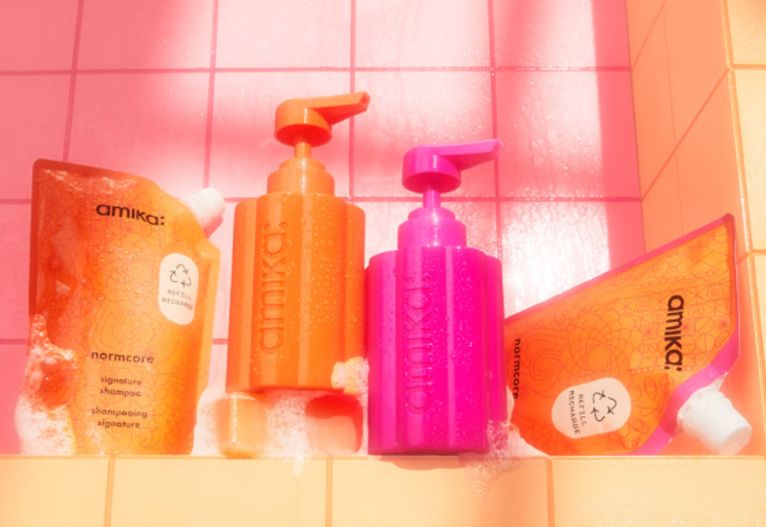
amika’s approach gives that permanent component a distinctive identity. The brightly coloured, sculpted pump bottles are designed to stand apart visually, while flexible refill packs provide the product needed to replenish them.
For me, that distinction between the permanent and replenishment components is important. If the reusable pack is going to remain in someone’s bathroom, there is an argument that it should be treated more like a durable object than disposable packaging.
Combining reuse with recycled content
The system also combines its refill model with the use of PCR material.
This is significant because refill and recycled content address different aspects of packaging material use. Rather than presenting refill as the only consideration, the system brings together a reusable primary container, recycled material and lower-material refill packs.
The claimed carbon benefit also provides a useful reminder that the impact of refill systems needs to be considered over multiple uses. According to amika, replacing two PCR bottles with refills each year results in a 69% reduction in packaging carbon footprint.
As with any refill system, the eventual impact will depend on how consumers actually use it, including whether they retain and repeatedly refill the reusable container.
Desirability as part of refill design
That feels especially important as refill moves beyond pilot schemes and towards more mainstream use.
Much of the conversation around refill understandably focuses on material reduction, refill infrastructure and consumer convenience. But design has a role to play too.
A technically effective refill system still needs people to want to participate in it. If the reusable component is distinctive, enjoyable to use and feels worth keeping, that may give consumers another reason to stay with the system rather than returning to conventional packaging.
For me, amika is a strong example of what good refill packaging can look like.
Reusable. Recycled. Distinctive. Desirable.
As more brands explore refill and reuse, perhaps the question shouldn’t only be whether the packaging can be refilled, but whether it has been designed to make consumers want to refill it.
Want to discover more packaging innovations?
Explore the latest developments and over 12,000 packaging innovations in the Innovation Zone.